Control signals are also based on energy, although significantly weaker than that needed to perform an action. This energy should be sufficient for stable communication and switching. Therefore, a control process can also be superimposed on the control energy. In this sense, the control signal and the source energy will be equal in power.
Let’s start the description of dual control with an example. If you prick your hand, the natural and unconscious reaction of a person will be to pull your hand away. If they take a blood test or clean a wound, we understand that it will be painful, or at least uncomfortable, and we hold our hand, not allowing our reflexes to work.
Conscious control and reflexive control are two different levels of response. Conscious control has a higher, more priority level of control. But at the same time, conscious control cannot be activated in response to any irritation: it does not have enough resources for this in the form of time and attention, signal processing abilities. Also, conscious control is usually centralized control, while reflexive control can be given to the periphery – closer to the switching point and closer to the sensor – the place where the signal and event originate. This will save on logistics for transmitting signals and events.
However, for conscious control it is more important to have a signal, since consciousness independently determines the threshold for the occurrence of an event. For example, we will withdraw our hand if the pain is unbearable or prolonged, but we can endure it a little longer.
With the need to suppress the reflex, the concept of switching-off control arises. If an action can only work to turn on, then excluding some local control (reflex control) from the chain, that is, taking control means temporarily disabling local control: by default, local control is turned on, but it can be turned off under the influence of central control. To disable reflex control, two sources of events must be used: 1) to disable local control, 2) to override centralized control.
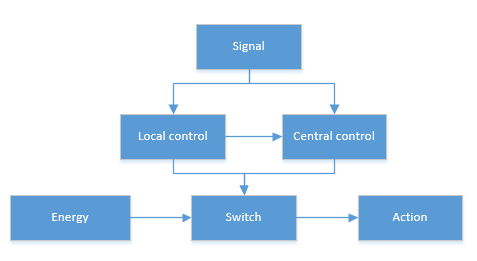
Another option for dual control is distributed control, when both sources have equal rights to switch the action. For example, when there are two different sensors, an event from one of them should trigger an action. This diagram is related to the logical rule of disjunction (“or”).
Another option for dual control is solidary control, when two control sources are interconnected into one control loop. For example, to eliminate errors or to increase reliability, the event must come from both sensors. This pattern is related to the logical rule of conjunction (“and”).
The fourth option is that the event should occur from only one sensor. In case an event occurs from two sensors simultaneously, the switch should not be activated. The role of the second sensor is inverse – it is activated in case of disagreement. For example, one sensor shows forward movement, the other – backward movement. There cannot be simultaneous movement – this gives rise to a contradiction, which means a sensor error. This circuit is related to the logical rule of exclusive disjunction (multiplication modulo 2, xor).