To be honest, a book is an outdated format. Modern people consume large volumes of text information daily, but more often in the form of articles with numerous hyperlinks and cross-links from various sources. Information is increasingly being assembled using AI chats. And it seems that books, especially technical or specialized ones, are fading into the background. But what motivated me to stick with this format? Consistency and integrity of presentation: over time, a huge number of articles have accumulated on my computer, written at different times when I wanted to express myself on a particular topic. Publishing all the articles separately would have meant overwhelming readers (and myself) with a confetti of meanings – disparate, unconnected by a single idea or style, and lacking consistency. Overall, a book, unlike communication with an AI, expresses a personal opinion, and does so in the author’s unique style. Moreover, a book has a purpose that is much greater than any single article or even a collection of articles. And, please note, all books are written without the use of AI (zero-AI). My first book, “Models of Information and Data,” was written in 2014 and published in 2018. It’s a book about data and information: the differences between these terms, their underlying concepts, and how they are expressed in human and machine representations. You can find the book and more information about it here: book “Information and data models” Much has been written about data for machines, but what is information for them? And how do humans perceive data and information as objects? These questions and their answers are explored in the book. Specifically, it describes images, categories (with a reference to ontology), signs (with a reference to semiotics as the study of signs), and operations with them. In addition to explanations, the book describes a super-normalized data structure that corresponds to signs and can be mapped to the principles of knowledge storage in the brain, concepts in natural languages, and is easily reflected in machine representation. This structure is called the “universe of data and information structures.” As an example, the book explains how this structure can be used to describe all known and familiar machine data structures – sets and lists, trees, concept maps, and even data models – infological (conceptual), network, relational, and document-oriented. Right now (at this very moment), I’m writing a three-book series. In contrast to my first book, which focused on data structures, these books explore processes for working with data, information, and knowledge. Three books emerged rather unexpectedly: when writing a book, you simply can’t plan the outcome right away, even if you want to cut and consider the value each line brings to readers, and its necessity. The overall title of the series is “Man Thinks About the Machine. The Machine Thinks Along with Man.” The first book in the “Man Thinks About Machines. Machines Think Along with Man” series is devoted to the phenomena of thinking – the basic principles and terminology of human thought, as well as how humans think in general, and how to separate pure thinking from biological, neural mechanisms in order to transfer them to a machine. The book is titled “Phenomena of Thinking”. At the beginning of this topic, we should address the fundamentals and causes: you will learn the starting point for the formation of thinking and consciousness, the outcome that thinking should generate, what it operates on, the stages it goes through, and the basic concepts it uses. Quite a few such principles and concepts have been collected – they are discussed before the conclusions and logical laws, which are yet to be addressed later. The book then describes the principles for constructing thinking mechanisms, which are based on mental practices and conceptual schemes. The book is ready as of March 2026, and I am currently discussing its publication. The second book in the “Man Thinks About Machines. Machines Think Along with Man” series is called “Atomic Meta-Informatics.” It is significantly more technocratic than the first book in the series. The book describes the emergence of automated and machine data processing from its very origins, gradually reaching the human level. You will learn the basis for data and information processing: movement generated by energy and force. The book then discusses the principles of data processing in the human brain –biological structures – and how they can be implemented in mechanical and other systems. Then, as you read the book, you will ascend to the next level – to abstract machines, processors, and then to programming languages as means of describing and implementing logic. Along with all types of programming languages, we will explore how to instill in machines the pure skills we wanted to see in them, and what these skills are. As of March 2026, the book is approximately 40% complete. I hope to complete it by September 2026. The final third book in the “Man Thinks About Machines. Machines Think Along with Man” series is “Conceptual Schemes”. It explores the mental rules we use in our daily activities, often without even noticing them, yet they shape the fabric of our minds, thinking, and consciousness. Conceptual schemes underlie habits and customs, skills and knowledge, and the realization of human abilities. Humans are also highly adaptive creatures: we are capable of creating new schemes and replacing instinctive reactions and behaviors with rational ones. The book examines the basic schemes that form what is called “rationality” – logical patterns of thought. But these schemes go beyond formal logic, which for some reason is considered the basis for thinking, even though it isn’t fully so. As of March 2026, the book is approximately 30% complete. I hope to finish the book by March 2027. Please email me (see contact page) if you want to be the first to receive the books, with your best wishes and autograph, of course.
The book “Information and Data Models”
The book series “Man Thinks About the Machine. The Machine Thinks Along with Man”
The book “Phenomena of Thinking”, book 1 of the “Man Thinks About the Machine. The Machine Thinks Along with Man” series
The book “Atomic Meta-Informatics”, book 2 of the “Man Thinks About the Machine. The Machine Thinks Along with Man” series
The book “Conceptual Schemes”, book 3 of the “Man Thinks About the Machine. The Machine Thinks Along with Man” series
How to get books
Why books?
The book “Information and Data Models”
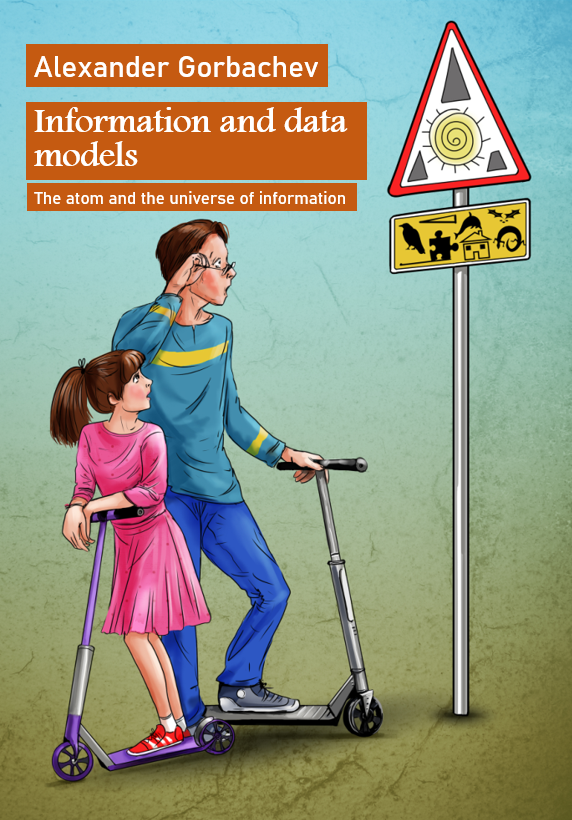
The book series “Man Thinks About the Machine. The Machine Thinks Along with Man”
The book “Phenomena of Thinking”
The book “Atomic Meta-Informatics”
The book “Conceptual Schemes”
How to get books
Books
Why books?